
 Champions for Change
 Remembering Our Sisters
 Brave Heart
 California Native Youth Collective
 Building Communities of Hope
 Creative Native
 Democracy is Indigenous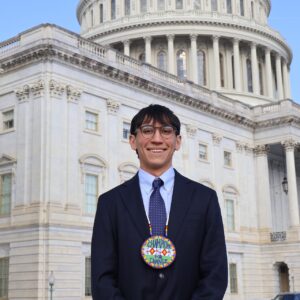
Sebastian April (he/him), Mi’kmaq, is a junior at the University of Connecticut (UConn) studying Plant Science with a minor in Cannabis Cultivation. His academic and professional interests focus on Tribal agriculture, cannabis policy and cultivation, and economic development in Indigenous communities.
Sebastian currently serves as Vice President of Outreach for UConn’s Native American & Indigenous Students Association (NAISA). In 2024, he was selected as an “Indigenous Summer Scholar” at Cornell AgriTech, where he explored Indigenous perspectives in agriculture and food systems. During the program, he worked alongside Cornell researchers and the USDA in Geneva, New York, participating in hemp and cannabis planting research. Following the internship, Sebastian contributed to published research alongside Dr. Chris Smart and PhD student Jocelyn Schwartz, and is a co-author on a research article published with The American Phytopathological Society (APS)/.
He is actively engaged in national Native policy and economic development spaces, having participated in programs and convenings such as CNAY’s Champs Week, the Reservation Economic Summit (RES) 2026, the National Congress of American Indians (NCAI) Annual Convention (2026) and the Intertribal Agriculture Council Annual Conference (2025).
Sebastian’s primary interest is Tribal cannabis cultivation and regulatory policy, and how the industry can support Tribal sovereignty, land stewardship and sustainable economic development. He is also interested in Tribal gaming and other tribally owned enterprises as drivers of long-term economic growth and self-determination.
Currently, Sebastian serves as a Youth Delegate for the Wabanaki Policy Youth Initiative, which uplifts the next generation of youth leaders in what is now called Maine to advocate for Wabanaki Studies education and Wabanaki sovereignty. Through this initiative, the Maine Environmental Education Association and the Wabanaki Alliance support a team of Wabanaki and non-Native youth ages 16–24 in learning about the legislative process and how to advocate effectively within their state legislature.